
The town of Cary, in North Carolina, has worked to implement sustainable fleet technology for over a decade. After purchasing the town’s first electric vehicle (EV) in 2012, the fleet department has continuously sought out ways to incorporate other vehicles to create a “green” fleet.
This past summer, Cary introduced the first electric fire truck on the east coast to their fleet, the Pierce® Volterra™ electric pumper. The vehicle is the first of its kind in North Carolina, featuring a dual power system that can run fully electric, with a diesel backup for calls that require extended efforts or in the case of a power outage.
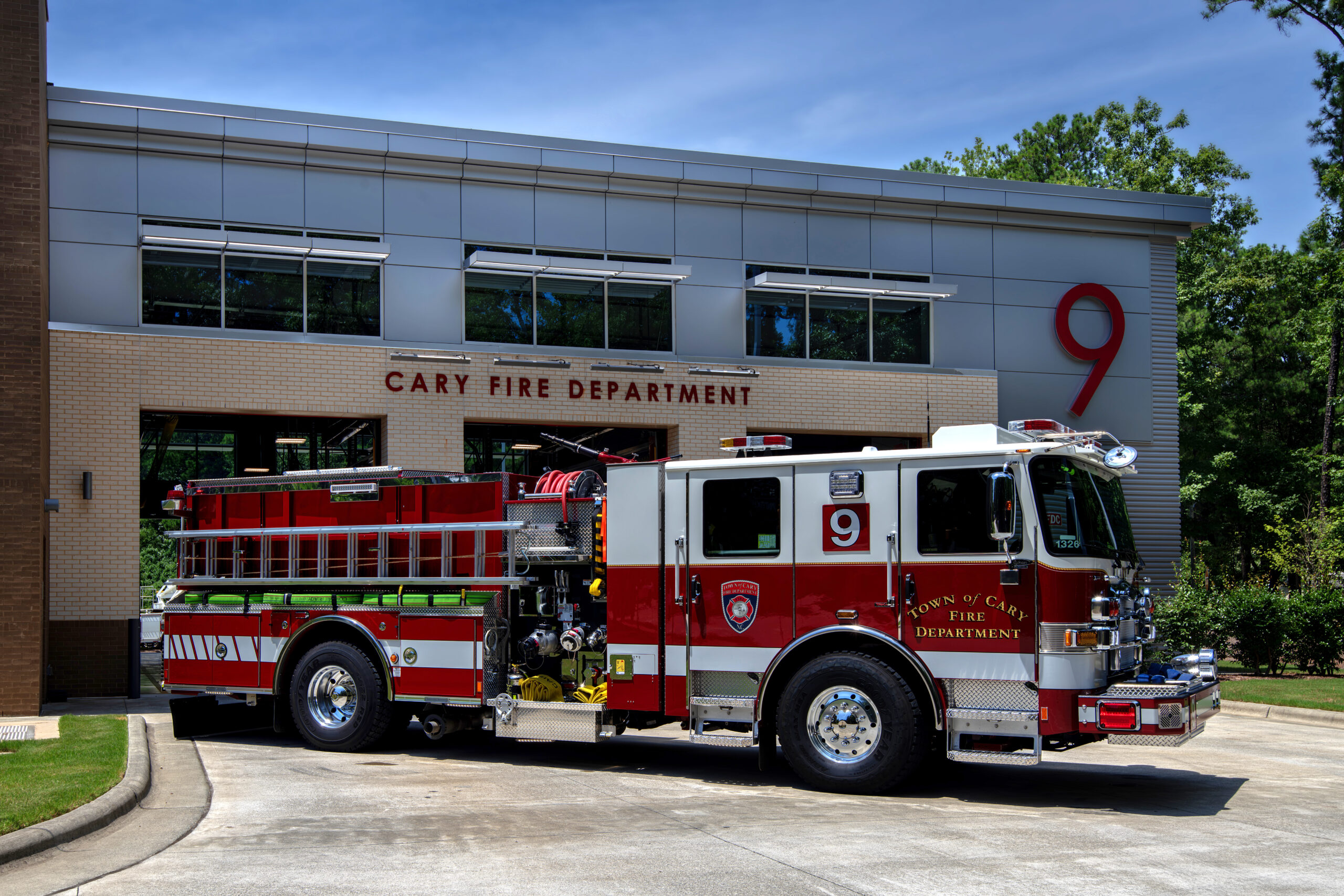
When the fire department first started looking at EV options, Town of Cary Assistant Fire Chief Parker said they wanted something reliable. The Pierce Volterra is exactly that, and is able to function either fully electric or fully diesel, allowing response times to remain unchanged in various conditions. Since putting the vehicle into operation in June 2025, Chief Parker says there has not been a time where they’ve had to use the diesel backup on a call.
Station 9 is home to the new pumper, where a 150 kilowatt DC fast charger has been installed to maintain the vehicle’s charge. As Station 9 is Cary’s newest fire station, installing the charger did not require as many electrical upgrades as an older station would. The retrofits to the station were minimal, as they already had transformers with available high power.
The pumper is hooked up to the charger each time it returns from a call, ensuring the battery is always fully charged. Chief Parker says this does not add significant time to their operations, as a lot of other equipment on the truck requires charging each time it returns to the station. The charger is mounted from the ceiling, with the cord hanging in line next to their other charging equipment. One of the benefits to having a vehicle without exhaust, is that it does not need to be hooked up to the station’s garage exhaust ventilation system. This system prevents vehicle exhaust from accumulating in the station while the truck is in the bay. Chief Parker noted that there are typically constant issues with these systems in normal operations, so being able to eliminate that risk is a large benefit.
In terms of performance, Chief Parker says they have instant power when accelerating, which is a nice change from the usual turbo lag that they experience in fully diesel trucks. He says it’s very important to get up to speed quickly from an intersection, which is something the new pumper is very capable of. As the Pierce Volterra is relatively new to Station 9, they don’t yet have specific data on the usable electric range of the vehicle. However, Chief Parker says that within its first two weeks of use, the truck was able to respond to an actual dwelling fire, during which several lines were flowed over a three-hour period. In a separate instance, the truck filled in at another station and performed normally during five or six calls throughout the day. When asked if there were any call types or coverage areas where the truck is intentionally not dispatched, Chief Parker says no, and that whichever truck is closest is called to respond, electric or not.
There have been no operational constraints when running multiple high-demand power loads simultaneously when responding to a fire, and the battery box in the truck is able to heat and cool itself to maintain 70° F at all times.
Chief Parker says the truck is very similar to how conventional trucks are operated. The main difference is there are two extra buttons in the cab, where an operator can switch to either diesel mode or electric mode. The mode can be switched very easily, even while the truck is moving on the highway. Chief Parker also says, “The truck is very smart, when it senses low battery, it will switch over to diesel on its own. If you’re inside and you can’t see, you will never know that it went to EV to diesel, or back and forth.” Another difference is that the cab is slightly smaller than conventional trucks due to the size of the battery box. Chief Parker says if they had to design it again, they’d raise the roof to give the firefighters more room, however their guiding principle was to prioritize performance.
Preventative maintenance for the new truck is relatively the same by design. There are a few additional coolant checks but otherwise the safety checks are exactly the same as a fully diesel truck. Chief Parker describes the truck as a “big toolbox”, so they make sure they check the equipment and inventory it every day.
He says they have had no more issues with the electric truck than what they’d have with a conventional truck. When they have experienced an issue, the manufacturer has been able to fly technicians in to repair it. Chief Parker says that they wanted to lead this initiative, recognizing that there would be a learning curve along the way.
Additional training was required for all of the drivers at the Cary Fire Department to ensure everyone felt comfortable operating the truck. “It’s a cultural change; they have to rely on and believe in the equipment to save someone’s life.” The manufacturer, Pierce, and the dealer, Atlantic Emergency Solutions, were present to teach the class and addressed the skills needed to work in high voltage areas. Atlantic Emergency Solutions also had their mechanics attend the training so that they could learn to service the new truck. The state also requires the department to train with mutual aid partners, and Station 9 often covers topics related to the electric pumper.
Chief Parker says the decision to purchase the new truck was “a calculated, intentional, environmental gain for the town.” He says the fire department is always looking for new vehicles because they age out after a certain amount of time. The Town of Cary has a long-standing relationship with Pierce, and when the opportunity came for Station 9 to acquire an electric pumper, they were excited to get the ball rolling.
For those interested in learning more and seeing the truck in person, Chief Parker invites everyone to visit. “We open our doors for people to come see what we’re doing. Come in, check it out, and ask questions. We’re very transparent.”